 Skip-the-line available
 What to See Inside Mosteiro dos Jerónimos
A room-by-room walkthrough of the church, the two-storey Manueline cloister, the chapter house, the refectory and the tombs of Vasco da Gama, Camões and Fernando Pessoa.
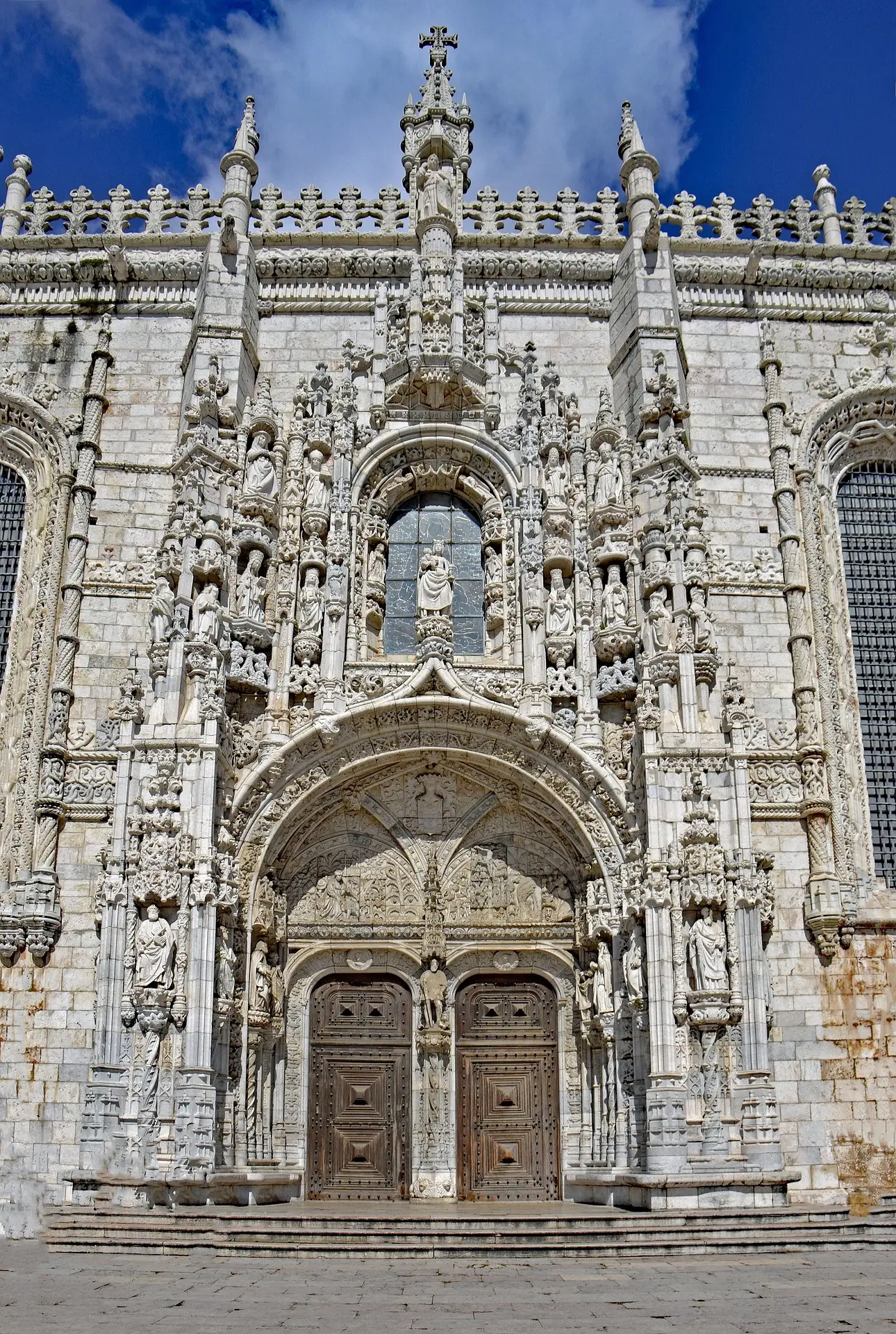
A visit to Mosteiro dos Jerónimos breaks down into four physical spaces: the church (Igreja de Santa Maria de Belém), the two-storey cloister, the chapter house and the refectory. Each rewards close attention — the church for its extraordinary stone net-vault and the matching tombs of Vasco da Gama and Luís de Camões, the cloister for the most complete Manueline carving programme in Portugal, the chapter house for Alexandre Herculano's nineteenth-century tomb and the refectory for the azulejo-tiled walls that survive almost intact from the Hieronymite period. This guide walks through the complex in the order most visitors take after entering through the priority lane, with notes on what to look for in each space and the small details that the audio guide tends to skip.
The Church: Igreja de Santa Maria de Belém
The church is the largest single space in the complex and the only part that remains a consecrated parish — the Paróquia de Santa Maria de Belém — with its own separate street-side entrance from the cloister visitor route. Inside, the headline feature is the stone net-vault overhead: a single continuous vault spanning three aisles and roughly twenty-five metres tall at the crown, supported on six slender octagonal piers carved with reliefs. The piers are remarkable for their thinness given the vault's span; the engineering is among the boldest in late-Gothic Portuguese architecture. Walk to the centre of the nave and look up before doing anything else.
The two most-visited tombs sit in the porch under the western entrance, one on each side. Vasco da Gama's tomb, carved in neo-Manueline limestone and supported on stone elephants, lies on the south side; the navigator's remains were repatriated to Portugal in stages from Cochin and finally laid here in 1898 to mark the four-hundredth anniversary of his voyage. Directly opposite on the north side, in a matching tomb installed at the same time, lies Luís Vaz de Camões — the poet of Os Lusíadas, the 1572 epic that turned Vasco da Gama's voyage into national myth. Camões himself never sailed to India in any documented capacity, though he spent years in Macau and East Africa. The 1898 re-installation of these two tombs in deliberately matching neo-Manueline canopies was a late-monarchy national-mythmaking gesture, and the visual pairing is the single most photographed view in the complex.
The Cloister: The Manueline Masterpiece
The two-storey cloister is the architectural heart of the monastery and the principal payoff of any visit. The lower gallery is by Diogo Boitac, begun around 1501; the upper gallery is by João de Castilho, completed in the 1540s. The four corners and the connecting arcades are carved in limestone with extraordinary density — every column capital is differently worked, every spandrel carries a different combination of Manueline motifs: twisted ropes, knots, coral, armillary spheres (the personal emblem of Manuel I), astrolabes, anchors, and the Cross of the Order of Christ. Walk the lower gallery first in a single full loop without stopping, just to register the overall rhythm; then walk it again slowly with attention to the carving.
The upper gallery is reached by a short flight of stairs in the north wing and is consistently quieter than the ground floor at every hour of the day. From the upper walk, the cloister courtyard reveals itself as a single composition — the four wings, the central garden, the slender Manueline columns ranged like a stone forest. This is the best photograph in the complex and the most reliable way to capture the cloister without other visitors in the frame. Fernando Pessoa, Portugal's most internationally translated twentieth-century poet, was reburied in the lower cloister's north wing in 1985 (the fiftieth anniversary of his death) in a tomb designed by the sculptor Lagoa Henriques. His placement here, among the royal tombs and the Discoveries-era piers, was a deliberate twentieth-century gesture of literary canonisation.
The Refectory and the Tile Programme
The refectory — the monks' communal dining hall — opens off the south wing of the lower cloister and is one of the most atmospheric single rooms in the complex. The space is long, narrow and barrel-vaulted, with a single carved limestone pulpit on the side wall where a reading monk would read scripture or theological texts aloud during silent meals. The walls below the vault springing are covered in eighteenth-century azulejos — blue-and-white Portuguese tin-glazed tiles depicting the life of Joseph from Genesis. The tiles are largely intact and form one of the most complete narrative azulejo programmes surviving in a Lisbon monastic interior.
Note that the refectory was a working monastic dining hall in continuous use from the early sixteenth century until the 1833 dissolution of religious orders. The wear pattern on the limestone door thresholds and the small shrine niche at the room's eastern end are original to the Hieronymite period. The room photographs well even at moderate visitor density because the long axis pulls visitors through quickly. Sit on the stone bench along the south wall for two or three minutes if you can; the room's acoustic — designed for a single reader's voice to carry over silent diners — is still apparent.
The Chapter House and Herculano's Tomb
The chapter house — where the monastery community gathered for daily readings, discipline and elections — sits off the east wing of the cloister and is reached through a carved Manueline doorway by João de Castilho. The room is smaller than the refectory but architecturally important: it contains the tomb of Alexandre Herculano, the nineteenth-century Portuguese historian, novelist and liberal politician who effectively founded modern Portuguese historiography. He was the first non-royal figure to be buried in the monastery; his interment here in 1888 was a deliberate state act recognising the role of historical scholarship in shaping the modern Portuguese nation.
Herculano's tomb is a sober nineteenth-century marble sarcophagus — a striking visual contrast to the elaborate Manueline carving everywhere else in the complex. The chapter house is one of the consistently quietest rooms in the monument at all hours because most tour groups concentrate on the cloister and the porch tombs and rarely linger in the chapter-house annexe. Read the small interpretive panel before leaving; it summarises the political context of Herculano's burial here, which is genuinely interesting and rarely covered in standard guidebook accounts of the building.
The Upper Choir and the Wider Royal Pantheon
The upper choir overlooks the western end of the church nave from a raised gallery and is accessible from the upper-cloister walk. This is where the Hieronymite community sang the daily office, and the carved wooden choir stalls — late-sixteenth-century work — survive in remarkable condition. From the choir balustrade you have an elevated view down the length of the church, with the high altar and the royal tombs of the Avis-Beja dynasty visible in the chancel and transepts: Manuel I (the founder), his wife Maria of Aragon, his son João III, Catarina of Austria, Sebastian I (the boy-king lost at the Battle of Alcácer Quibir in 1578) and Cardinal-King Henry.
The Avis-Beja line ended in 1580 with Cardinal-King Henry's death and Portugal entered a sixty-year personal union with Habsburg Spain — a period during which Jerónimos continued to function as a working monastery. The tombs are visible from the central nave but cannot be approached closely; visitors stand at the chancel rail. The upper-choir view delivers a different perspective on the same royal pantheon and is one of the most underused photographic vantages in the complex. Allow ten minutes for the choir and the side-aisle views before descending back to the cloister.
Frequently asked
Is the church free to enter without a ticket?
Yes. The Igreja de Santa Maria de Belém is an active parish and can be entered without a monastery ticket through its own street-side entrance. The ticketed visit covers the cloister, the chapter house, the refectory and the upper choir.
Where is Vasco da Gama buried?
In the porch under the western entrance of the church, on the south side. His remains were finally interred at Jerónimos in 1898 to mark the four-hundredth anniversary of his voyage to India. Luís de Camões lies in a matching tomb directly opposite on the north side.
Is Fernando Pessoa's tomb really inside the monastery?
Yes. Pessoa was reburied in the north wing of the lower cloister in 1985, fifty years after his death. The tomb was designed by the sculptor Lagoa Henriques and is one of the most-visited spots in the cloister.
Can I photograph the cloister?
Yes — personal photography without flash or tripod is permitted throughout the cloister and the church. Tripods and commercial shoots require advance written permission from the operator.
Is the upper cloister gallery worth the climb?
Yes — the upper gallery is consistently quieter than the ground floor and is the best place to photograph the two-storey cloister from above. The stairs are short (about a single flight) in the north wing.
What is azulejo tilework?
Portuguese tin-glazed ceramic tiles, typically blue-and-white from the eighteenth century, used to cover walls in churches, monasteries and private houses. The refectory at Jerónimos has one of the most complete narrative azulejo programmes surviving in a Lisbon monastic interior.
Are the royal tombs accessible to visitors?
The Avis-Beja royal tombs in the chancel of the church are visible from the central nave but cannot be approached closely; visitors stand at the chancel rail. The Vasco da Gama and Camões tombs in the church porch are the only tombs you can stand directly beside.
How long should I budget for a thorough visit?
Seventy-five to ninety minutes is the standard recommendation for the church, cloister, chapter house, refectory and upper choir. Visitors particularly interested in Manueline architectural detail typically spend two hours.
Is the chapter house always open?
It is open as part of the standard ticketed route whenever the cloister is open. Occasional partial conservation closures are announced in advance on the operator's website and rarely affect headline rooms.
Can I attend Mass in the church?
Yes. The Paróquia de Santa Maria de Belém celebrates Mass on weekdays and Sundays; attendees enter through the church's street-side door and do not need a monastery ticket. Modest dress is expected — shoulders and knees covered.