Adult (Monastery only)
Ages 25+ — or any age without ID for the discount
€35per person
- Skip-the-line entry to the Jerónimos Monastery cloister
- Tombs of Vasco da Gama and Camões in the church
- 16th-century Manueline cloister + monks' refectory
Belém · Lisbon · on the Tagus
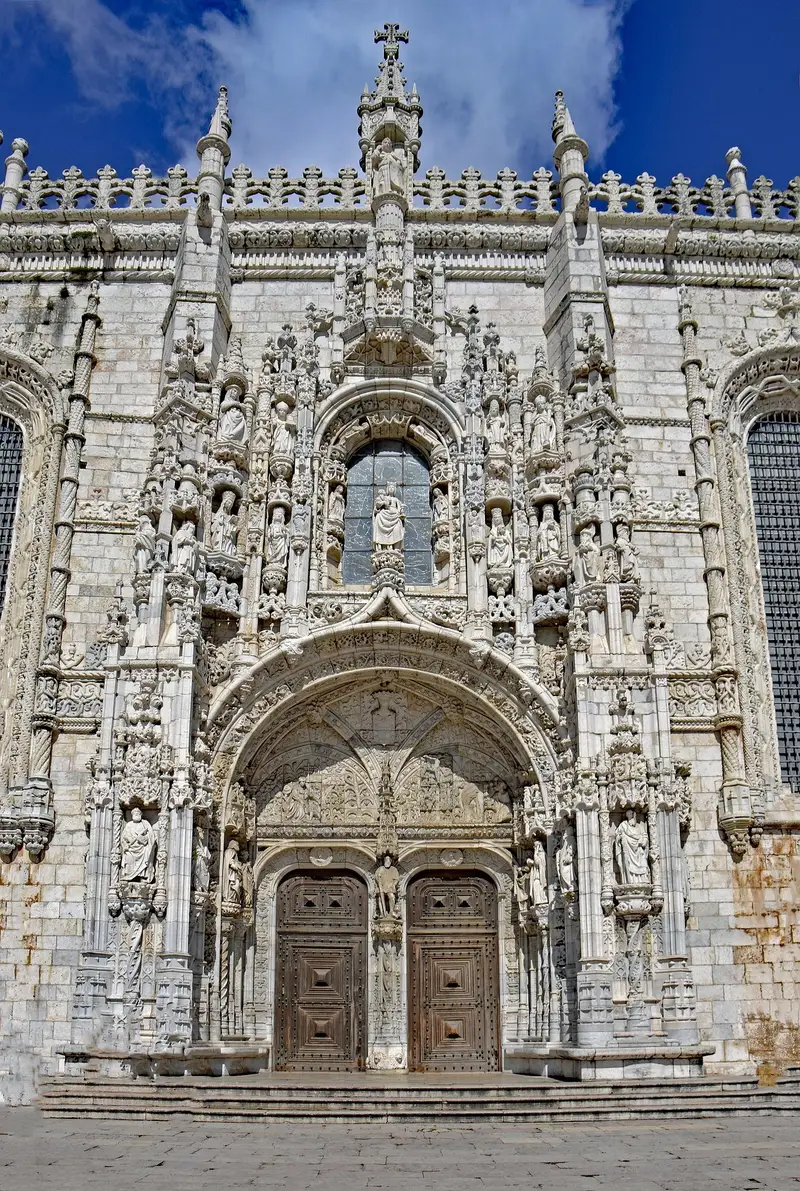
A church and cloister carved for sixty years out of butter-coloured limestone, paid for with the pepper of the first sea route to India, and still holding Vasco da Gama and Camões three metres apart.
Four bearings
Fleet manifest
Pick the ticket that matches your morning. We buy the official dated ticket in your name after you pay, send it as a PDF with a QR code, and stay on call in your language until you are inside.
Ages 25+ — or any age without ID for the discount
€35per person
Adult — both monuments, same day
€52per person
Ages 13 to 24 — photo ID required at the gate
€21per person
Cargo hold
Why a king built a cathedral-sized monastery on a riverbank, and what the stone is trying to tell you.
Mosteiro dos Jerónimos was begun in 1501 on the orders of King Manuel I, on the spot where Vasco da Gama and his crew had spent their last night ashore before sailing to India in 1497. It was paid for in pepper. The Portuguese crown levied a 5% tax on the spices arriving from the East, and that revenue funded the most ambitious building project of the Portuguese Renaissance.
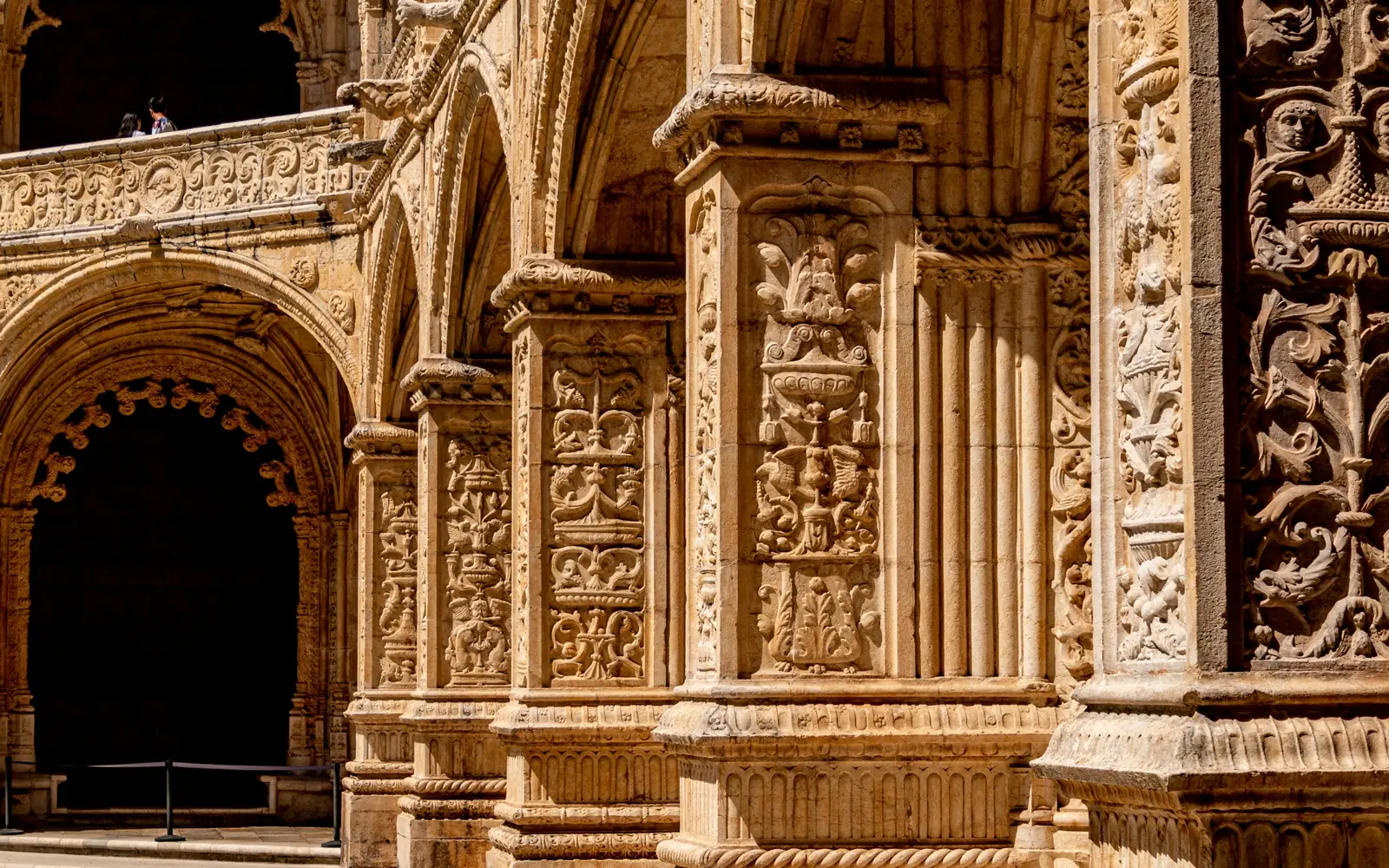
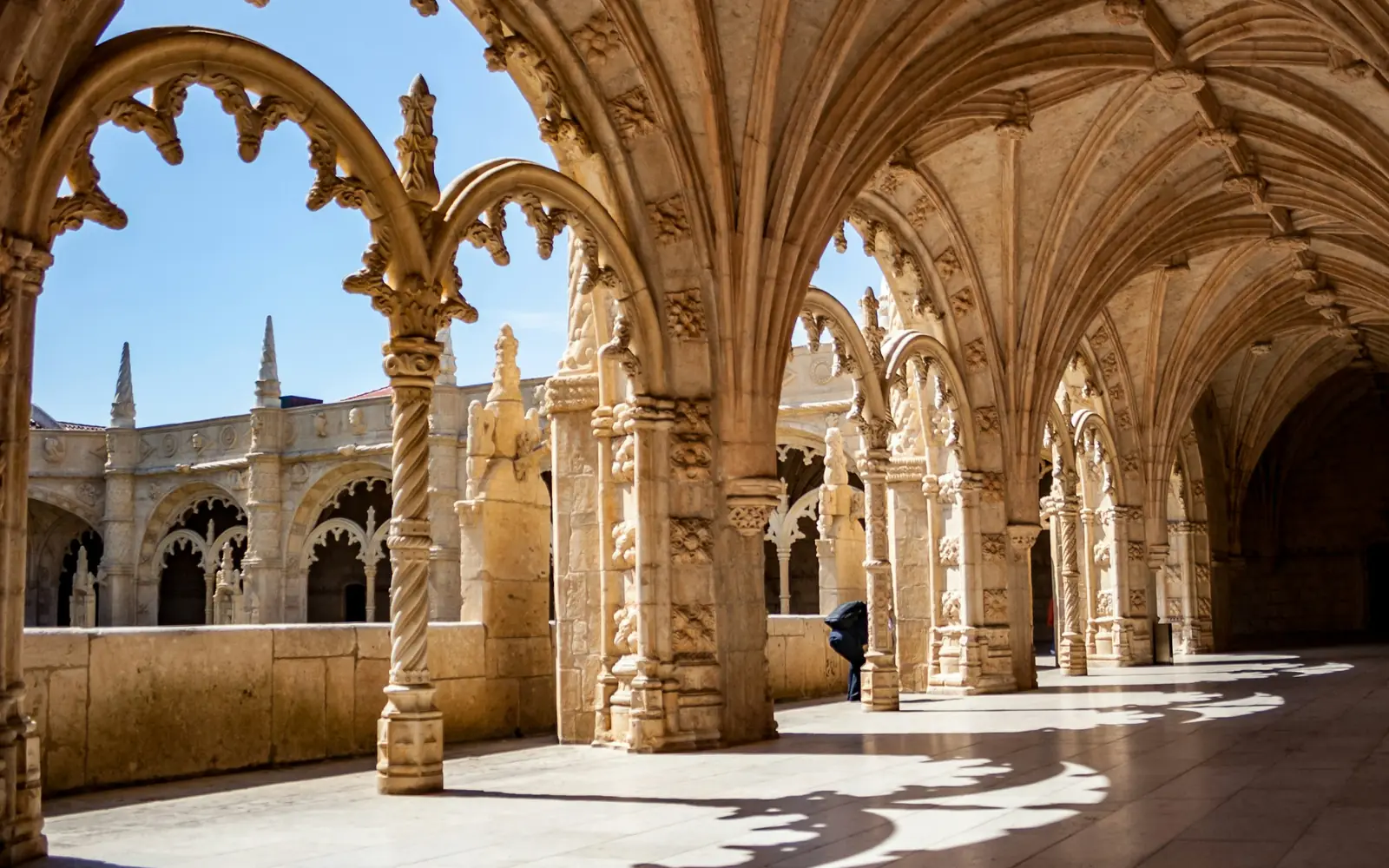
The architecture is Manueline — a uniquely Portuguese late-Gothic style that fuses ribbed vaults and pointed arches with rope, knot, coral, and astrolabe motifs carved into the stone. Diogo Boitac began it; João de Castilho finished the cloister and the church's south portal. The cloister itself is the building's masterpiece: a two-storey square of carved limestone where every column is different.
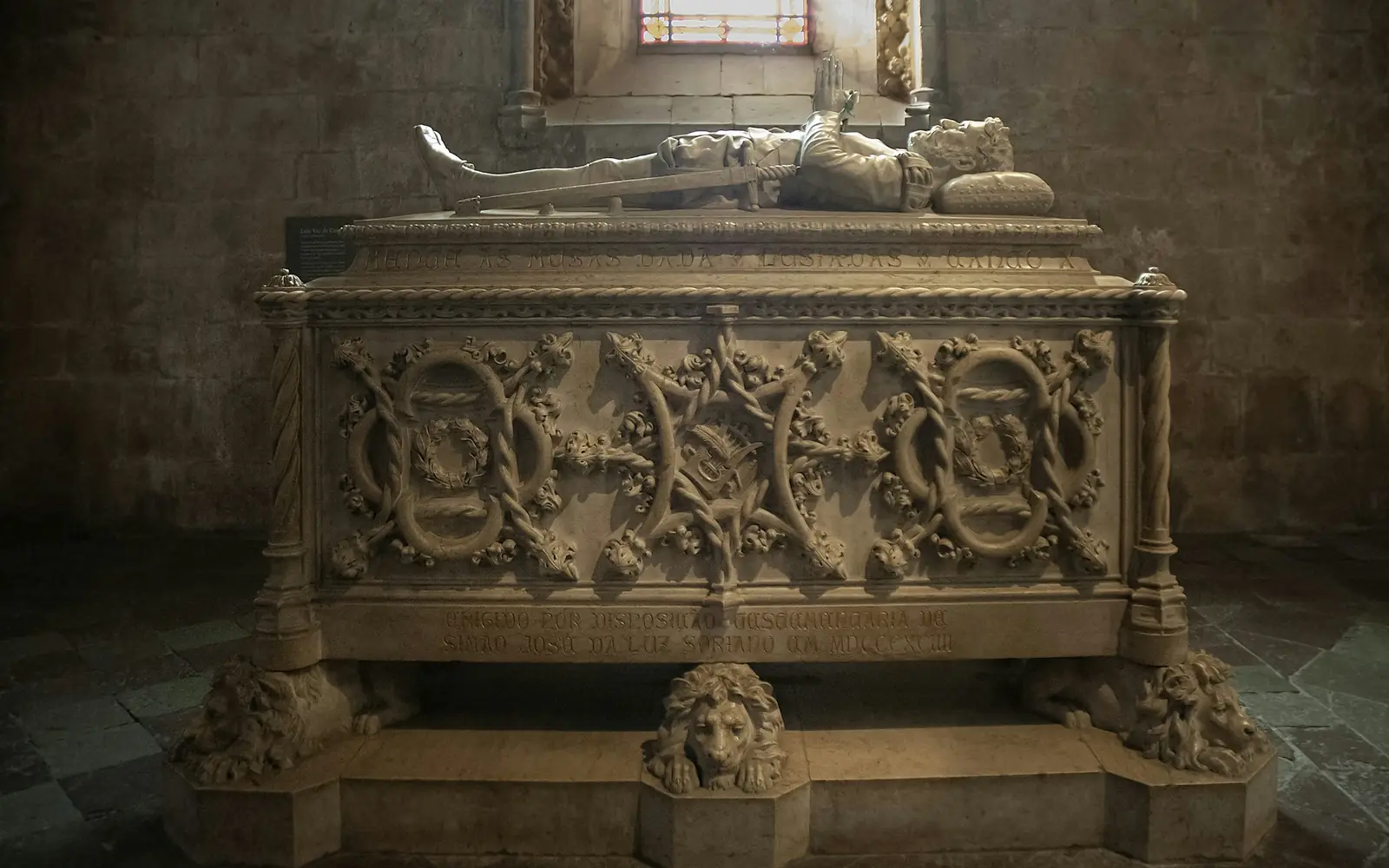
Inside the church, two tombs sit in the porch on either side of the western entrance. On the left lies Vasco da Gama, the navigator who opened the sea route to India. On the right lies Luís Vaz de Camões, the poet whose Os Lusíadas turned that voyage into Portugal's national epic. The tombs were placed there in 1898, four hundred years after the voyage. The monastery survived the 1755 Lisbon earthquake almost intact — one of the few buildings in Belém that did.
Vasco da Gama's tomb, the spice-trade financing, the Manueline stonemasons, and why Camões sleeps three metres from him. Five minutes, narrated for visitors before they go in.
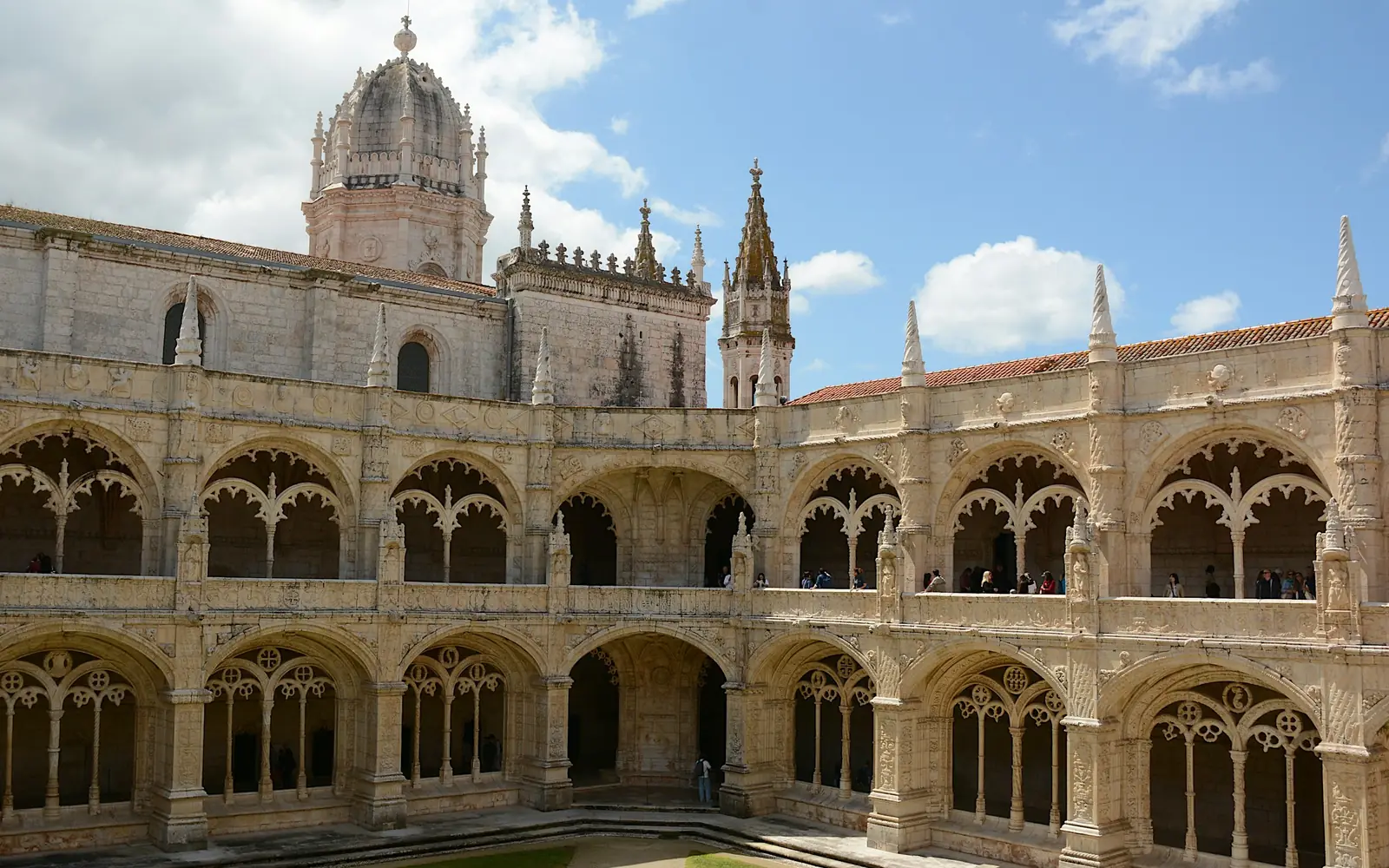
Mosteiro dos Jerónimos — also called the Jerónimos Monastery, the Hieronymites Monastery, or simply Belém Monastery — is a 16th-century monastic complex on the western edge of Lisbon, in the suburb of Belém. King Manuel I founded it in 1501 on the spot where Vasco da Gama and his crew had spent their last night ashore before sailing to India in July 1497. The monastery was funded by a 5% tax on the spices arriving from the East — the financial product of the very voyage commemorated by the building. Construction continued for almost a century. UNESCO inscribed it as a World Heritage Site in 1983, jointly with the nearby Belém Tower.
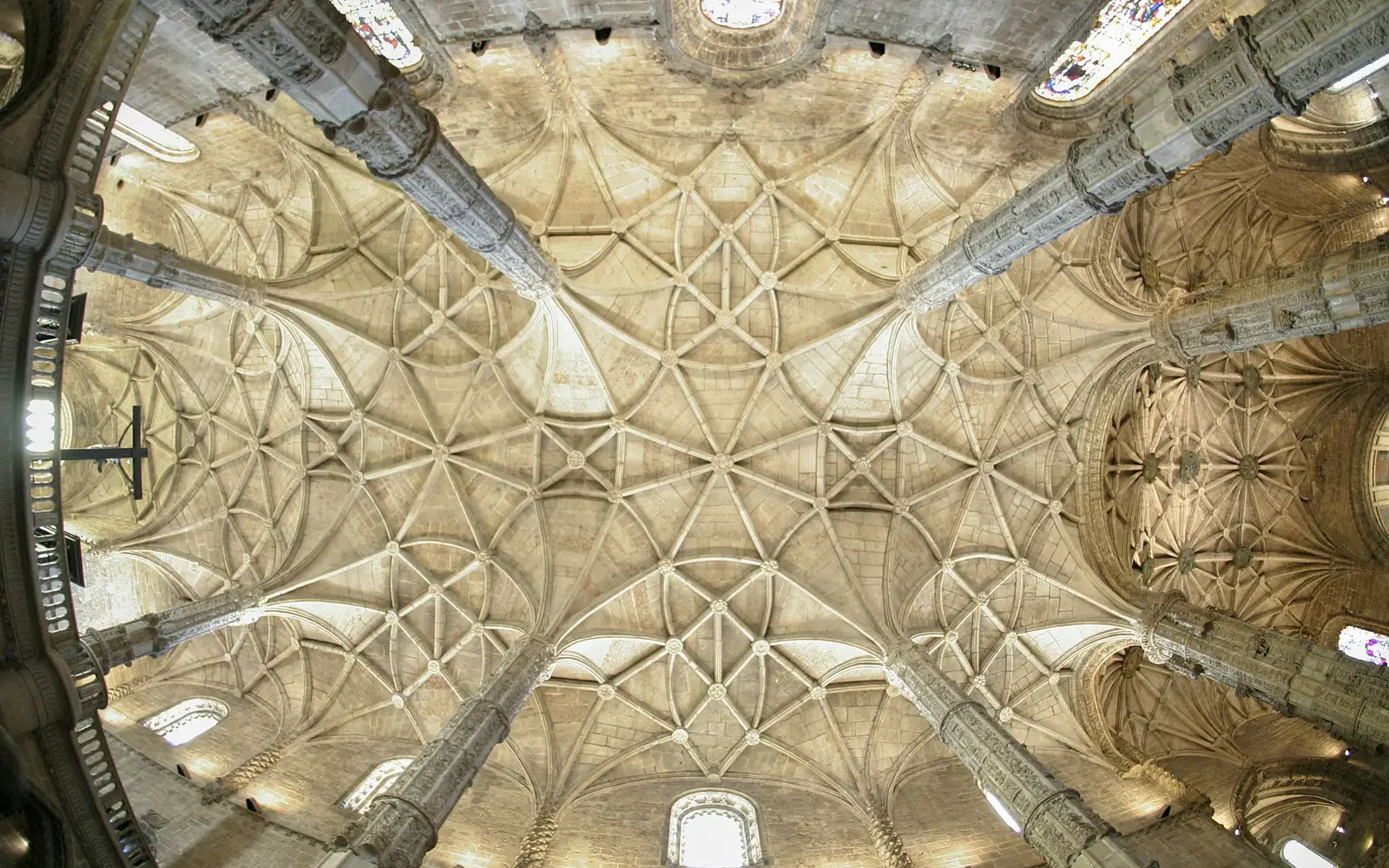
Architecturally it is the most complete surviving example of Manueline — Portugal's signature late-Gothic / early-Renaissance style. Diogo Boitac began the church and cloister; João de Castilho took over c.1517 and finished the south portal and the cloister's elaborate carved limestone tracery. The result is a building where every column in the two-storey cloister is different: ropes, knots, coral, armillary spheres, astrolabes — all symbols of Portugal's Age of Discoveries — appear as carved motifs alongside conventional Gothic ribbed vaults. The complex includes the Igreja de Santa Maria de Belém (the church), the cloister, the refectory, and the chapter house, plus the west wing now occupied by the Maritime Museum and the National Archaeology Museum (separate tickets).
The monastery takes its name from the Order of Saint Jerome — the Hieronymites — a Catholic monastic order Manuel I installed here at the turn of the 16th century to staff the new foundation. The Hieronymites' role was specific: provide spiritual care for sailors departing for and returning from the East, and pray for the souls of mariners lost at sea. They occupied Jerónimos for over three centuries, leaving in 1833 when Portugal's liberal-era reforms dissolved religious orders nationwide and transferred monastic property to civil ownership. The complex today is administered as a national heritage site by Museus e Monumentos de Portugal; the Igreja de Santa Maria de Belém remains an active parish church — Paróquia de Santa Maria de Belém — with its own street-side entrance, separate from the cloister visitor entrance.
Skip-the-line at Mosteiro dos Jerónimos is an official Museus e Monumentos de Portugal product. When you book online (with us or directly), your ticket carries a QR code and a designated arrival window. At the monastery entrance on Praça do Império, there are two queues: the standard ticket-counter queue (which can hit 45–90 minutes on summer weekends) and a much shorter priority lane for online ticket holders. You go to the priority lane, staff scan your QR, you pass through, and you are inside the cloister within 5 minutes regardless of how busy the standard queue is.
The QR ticket arrives by email as a PDF. Show it on your phone or print it. Don't show the booking confirmation — staff scan the QR inside the PDF, not the email or the receipt. We re-send the PDF 24 hours before your visit so it's at the top of your inbox the day you need it.
If you arrive earlier than your slot window, staff in the priority lane will usually scan you in immediately if the lane is moving — there is no formal hold for early arrivals. Late arrival policy is at staff discretion; turn up close to your slot. The priority lane is signposted in Portuguese and English on the right-hand side of the main Praça do Império entrance. If your QR fails to scan (occasionally happens with low-resolution screenshots or a dim phone screen), staff can manually look up your booking by surname or order reference — keep your confirmation email accessible on your phone as a fallback. The on-site ticket office sells the same standard tickets at the same price, but cannot resell a missed priority slot, so plan to be at the entrance with the QR ready before your slot begins.
Yes, for almost every visitor. The Tower of Belém (Torre de Belém) is 300 metres along the riverfront from the monastery — a flat 5-minute walk past the Padrão dos Descobrimentos. It is the same UNESCO listing, the same operator, the same Manueline style, and arguably the more photogenic of the two on a sunny day. The combo ticket reserves entry slots at both monuments on the same morning so you don't have to backtrack or queue twice.
Skip the combo only if you have less than two and a half hours total in Belém, or if you actively dislike spiral staircases (the Tower's narrow internal staircase is the only way up to the upper terrace). The monastery is largely level on the ground floor and weather-independent. The Tower's open-air upper terrace is exposed — heavy rain or extreme heat (Lisbon hits 35°C on the worst July afternoons) makes it less pleasant. Most combo visitors do the monastery first, walk to the Tower for the view across the Tagus estuary, then finish with a pastel de nata at Pastéis de Belém on the way back.
If you book the combo through us, the simplest sequence is: arrive at the monastery 10 minutes before your slot, do the priority lane, allow 75-90 minutes inside (church + cloister + chapter house), exit, walk along the riverfront promenade past the Padrão dos Descobrimentos (10-12 minutes), arrive at the Tower with 15-20 minutes of buffer. The Tower visit itself takes 45-60 minutes including the upper-terrace queue for the spiral staircase. Total time budget for the combo: 3 to 3.5 hours, plus another 30-40 minutes if you stop at Pastéis de Belém on the walk back. The combo ticket reserves both slots on the same morning and is not splittable across two days. Both monuments use the same operator and the same QR-code scanning infrastructure — one ticket, two scans.
Mosteiro dos Jerónimos is busiest from May through September and at Christmas / New Year. On peak July and August Saturdays the standard ticket-counter queue can reach 90 minutes; the cloister itself becomes notably crowded after 11:00 as day-trip groups arrive on Tram 15E from central Lisbon. June 13 — Lisbon's Festas de Santo António, the city's saint's day public holiday — is the single busiest day of the year, with the monastery operating at capacity and tram services to Belém running standing-room-only.
Quietest windows: Tuesday, Wednesday, or Thursday in the first hour of opening, and the last 90 minutes before close on a non-summer weekday. Closed Mondays year-round. Closed Jan 1, Easter Sunday, May 1, June 13, and Dec 25.
Within a busy day the cloister has two distinct waves. The morning wave starts as Tram 15E disgorges the first cruise-ship and day-trip groups, peaks around midday, and partially clears as groups break for lunch. The afternoon wave runs through mid-afternoon and is dominated by independent travellers and post-lunch tour groups; it tends to be slightly less crowded than midday because school groups have usually moved on. The chapter house and refectory upstairs are consistently quieter than the main cloister at all hours — most groups concentrate on the ground-floor cloister and rarely climb to the upper gallery. Portugal's summer school break runs from late June to mid-September, plus Christmas and Easter weeks, adding domestic-visitor volume on top of the international tourist baseline.
Belém is 6 kilometres west of central Lisbon along the Tagus riverfront. There are three sensible routes. Tram 15E is the most scenic and the most popular: catch it at Praça da Figueira (central Baixa) or Cais do Sodré (riverfront); the trip takes roughly 25 minutes and stops 100 metres from the monastery entrance. The train from Cais do Sodré on the Cascais line is faster (12 minutes to Belém station) and avoids tram-route traffic, but the station is a 5-minute walk from the monastery via the underpass beneath Avenida da Índia. Buses 728, 729, 714, 727 and 751 all serve the Belém riverfront. Lisbon's metro does not extend to Belém.
Driving is possible but parking is limited. The closest paid car park is at Centro Cultural de Belém, 200 metres east. Rideshare (Uber / Bolt) drops you at the gates. If you're staying at one of the riverfront hotels in Alcântara or Belém itself, the monastery is a 10-15 minute walk.
Tram 15E runs frequently during daytime hours and accepts the standard Lisbon Viva Viagem rechargeable card; the zapping (top-up) fare for a single tram, bus, or metro ride is charged at a reduced rate, considerably cheaper than buying a single ticket on board. The tram is iconic but rarely empty — expect to stand from Praça da Figueira onwards on summer mornings. The Cascais-line train from Cais do Sodré is more comfortable and the better choice in heavy rain or with mobility issues; the same Viva Viagem card works. Returning to central Lisbon in the late afternoon, the train is significantly faster than the tram because the tram gets caught in returning rush-hour traffic. If you're heading directly from Belém to Sintra by train, take the Cascais line back to Cais do Sodré and connect via Rossio.
Belém is dense with sites. Most visitors do the monastery, the Tower, the Padrão dos Descobrimentos (a 1960 modernist sculpture monument to Portugal's navigators — free to view from outside, small fee for the rooftop), and Pastéis de Belém in a single half-day. The Maritime Museum and National Archaeology Museum occupy the monastery's west wing on separate tickets — both worth an hour if you have a marine-history or ancient-history interest. MAAT (Museum of Art, Architecture and Technology), 400 metres east along the river, is a striking Amanda Levete building with rotating contemporary exhibitions.
Pastéis de Belém at Rua de Belém 84-92 is the original pastel de nata bakery — opened 1837, still using the same recipe. Expect a 20-minute queue at the takeaway window or 40 minutes for a table inside. The pastéis are warm-out-of-the-oven and noticeably better than supermarket versions; eat one with cinnamon and powdered sugar.
Beyond Pastéis de Belém, the riverfront has several restaurant options for a longer lunch — most cluster around Doca de Belém and the marina just east of the Padrão dos Descobrimentos. Tropical Botanical Garden (Jardim Botânico Tropical), 200 metres north of the monastery, is a 19th-century botanical collection of Portugal's former-colony flora; it's free or low-cost and rarely busy. MAC/CCB — Museum of Contemporary Art and Architecture Centre — at the Centro Cultural de Belém directly opposite the monastery (rebranded from Berardo Collection Museum in October 2023) holds significant 20th- and 21st-century works including the Berardo Collection deposit alongside other major Portuguese collections. CCB also has a café-bar terrace overlooking the monastery facade — a pleasant spot to debrief after the visit before heading back to Lisbon.
Typically Tuesday–Sunday with seasonal winter / summer hours and last admission 30 minutes before close. Address: Praça do Império 1400-206 Lisboa. The monastery accepts card and contactless at the on-site ticket office. The cloister and church are mostly level on the ground floor; the cloister upper gallery has step access only.
Bag policy: small daypacks fine inside; anything larger goes to the cloakroom (free). No food or drink inside. The visit is mostly indoor / covered, so weather is rarely an issue inside the building — but the 300m walk to the Tower and the riverfront walk to Pastéis de Belém are both fully exposed.
Wheelchair access is good on the ground floor — the church, cloister, refectory, and chapter house are all step-free with ramped thresholds where the original limestone has uneven joints. The upper-gallery cloister walk is reachable only by stairs and remains the one major part of the visit not accessible to wheelchairs. Stroller users have the same constraint. Photography is permitted for personal use throughout the cloister and the church without flash or tripods; commercial photography requires a permit in advance. There are toilets near the ticket office and inside the cloister. The complex does not have an on-site restaurant, but the CCB next door and the Pastéis de Belém bakery are both within 200 metres. Audio guides are available at the entrance in English, Portuguese, French, Spanish, and German for a small extra fee paid at the ticket office.
Two of the most important tombs in Portuguese history sit in the porch of the church on either side of the western entrance. On the left lies Vasco da Gama, the navigator whose 1497–99 voyage to India opened Europe's sea route to Asia and made Portugal, briefly, the wealthiest crown in Europe. He died in Cochin in 1524; his remains were repatriated to Portugal in stages and were finally laid in Jerónimos in 1898 to mark the 400th anniversary of the voyage. On the right, in a matching tomb installed at the same time, lies Luís Vaz de Camões — the poet of Os Lusíadas (1572), the national epic that turned Vasco da Gama's voyage into a Homeric narrative. Camões himself never sailed to India in any documented capacity, though he spent years in Macau and East Africa and lost an eye fighting in Morocco.
Beyond the porch tombs, the church holds royal tombs of the Avis-Beja dynasty in the chancel and transepts: Manuel I (the founder), his wife Maria of Aragon, Sebastian I, and Cardinal-King Henry. Manuel I's tomb sits in a granite niche on the right of the high altar. The Avis-Beja line ended with the death of Cardinal-King Henry in 1580, after which Portugal entered a 60-year personal union with Habsburg Spain — a period during which Jerónimos continued to function as a working monastery.
Fernando Pessoa — Portugal's most internationally translated 20th-century poet — was reburied in the lower cloister of Mosteiro dos Jerónimos in 1985, fifty years after his death, in recognition of his standing as the country's modernist literary giant. His tomb, designed by the sculptor Lagoa Henriques, sits in the north wing of the lower cloister and is one of the most-visited spots in the complex. Manuel I and the Avis-Beja royal tombs in the chancel of the church are visible from the central nave but cannot be approached closely; visitors stand at the chancel rail. The Vasco da Gama and Camões tombs in the church porch are the only tombs you can stand directly beside. The 19th-century re-installation of these two tombs in matching neo-Manueline canopies was a deliberate national-mythmaking gesture by the late-monarchy state.
Manuel I chose the site for two reasons. First, it was where Vasco da Gama's crew prayed at the small Ermida do Restelo — a hermitage of the Order of Christ — the night before they sailed for India in July 1497. The new monastery was conceived as a thanksgiving for the safe return of the voyage and a marker of Portugal's new role as Europe's gateway to the East. Second, Belém in 1500 was the working riverfront where Portugal's ships of discovery actually departed and returned. Building the monastery here put it on the route of every voyage. Crews approaching home from Africa and Asia would see it from the river. Crews leaving for new voyages prayed there before crossing the bar of the Tagus. The monastery and the Tower were both inseparable from the practical infrastructure of the spice trade.
By the time the building was substantially complete, in the 1580s, the spice trade itself had begun to shift away from Lisbon — first to Spanish Seville, later to Dutch Amsterdam and English London. The monastery survived as a working religious institution until 1833, when liberal reforms dissolved Portugal's monasteries and converted Jerónimos to civil ownership. The 1755 Lisbon earthquake destroyed most of central Lisbon but spared Belém — the monastery is one of the few major pre-1755 buildings still standing as it was originally constructed. Restoration work in the 19th and 20th centuries added the western annexe (now the Maritime Museum) but left the cloister, church, and refectory largely as Manuel I's masons left them.
Mosteiro dos Jerónimos and the Belém Tower were built as a paired statement — the monastery as the spiritual face of the Discoveries, the Tower as their military and ceremonial face. Both occupy the riverfront within sight of each other; both use the same Manueline visual vocabulary; both were funded by the same spice-trade revenue. Together they framed every voyage's departure and return through the Tagus. The 1755 earthquake — one of the most destructive seismic events in European history, killing tens of thousands in central Lisbon and triggering a tsunami that swept up the Tagus — left Belém comparatively unscathed because the suburb sat on more stable bedrock than the alluvial plain of the city centre. That accident of geology is the main reason these two monuments survive in their original Manueline form when most of pre-1755 Lisbon does not.
Navigational fix
Everything practical in four quadrants: where it is, when to go, what to bring, and how the ground is underfoot.
Address. Praça do Império 1400-206 Lisboa, Portugal
Getting there. Tram 15E from central Lisbon (Praça da Figueira or Cais do Sodré) takes ~25 minutes and stops 100m from the monastery entrance. Train: Belém station on the Cascais line, 5-minute walk. Bus: routes 728, 729, 714, 727, 751.
Time needed. Tuesday–Friday early morning (first hour of opening) is the calmest window. Saturdays from late morning are heaviest. Closed Mondays. Avoid June 13 (Lisbon's Saint Anthony public holiday) — the city is at peak crowding.
What to wear. Comfortable shoes (the limestone cloister floors are uneven). Water (no fountains inside). Camera — the cloister is one of the most photographed pieces of architecture in Portugal. The interior is largely indoor, so weather doesn't disrupt the visit.
Accessibility. The ground floor of the cloister and the church nave are level. The cloister upper gallery has step access only. Wheelchair access is available to most spaces — email us before your visit for the routing notes.
Wayfinder's notes
What booking through us actually changes about the day.
Your currency, final price.
Best times, secret spots, the room most visitors miss.
Mobile ticket, ready in your inbox.
Real people, any hour, any time zone — 24/7, in your own language, right through to your visit day.
Captain's logbook
Longer reading for people who like to know what they are looking at.
Soundings
Straight answers on the ticket, the tombs, the queue and the day itself.
There's no meeting point with us — we are your booking concierge, not an on-site tour. Bring the PDF QR ticket we email you and walk to the monastery entrance on Praça do Império. Skip-the-line ticket holders use the priority lane signposted for online bookings; staff scan your QR and you're inside in 5 minutes.
Smart-casual is fine. The monastery is still a working religious site — shoulders covered is appreciated in the church. No backpacks larger than a small daypack inside. No tripods without a permit.
No. They are two separate UNESCO World Heritage buildings in the Belém district of Lisbon, about 300 metres apart along the riverfront. Both share the 1983 UNESCO listing and both are operated by Museus e Monumentos de Portugal. Our combo ticket covers both.
Inside the church, in the porch immediately to the left of the western entrance. The tomb dates to 1898 — Vasco da Gama died in 1524 in Cochin and his remains were repatriated to Portugal in stages. The matching tomb on the right holds Luís Vaz de Camões, the poet of Os Lusíadas.
A late-Gothic / early-Renaissance Portuguese style that flourished c.1490–1520 under King Manuel I. It fuses Gothic ribbed vaults with carved maritime motifs — ropes, knots, coral, armillary spheres, astrolabes — that celebrate the Age of Discoveries. Jerónimos and the Belém Tower are the two most complete Manueline monuments in the world.
Yes, almost intact. The earthquake destroyed central Lisbon and two-thirds of the city. Belém, a few kilometres west on stable ground, escaped with minor damage. The monastery is one of the few pre-1755 monuments standing more or less as Manuel I built it.
The ground floor of the cloister and the church nave are generally level; the cloister upper gallery and parts of the refectory may be step-only.
Most visitors spend 60–90 minutes inside. Photography enthusiasts often spend two hours in the cloister alone. The Maritime Museum and National Archaeology Museum (in the west wing) require separate tickets and a separate hour each.
First hour of opening on a Tuesday, Wednesday, or Thursday. The cloister is at its photographic best when the morning sun catches the upper-gallery columns from the east. After 11:00 the cloister fills with day-trip groups arriving on Tram 15E.
The monastery as a religious institution was dissolved in 1834 when Portugal disbanded all religious orders. The building is now a museum operated by Museus e Monumentos de Portugal. The church (Igreja de Santa Maria de Belém) remains consecrated and holds occasional services; the rest of the complex is purely museum.
Yes, in the cloister, refectory, and church. No flash. No tripods without a permit. The royal tombs in the church are popular photography spots — staff politely ask visitors not to lean on the tombs.
Children aged 12 and under enter free — no ticket is required for them, just bring ID showing their age at the gate. Our Reduced ticket covers ages 13–24 (photo ID required at the gate), and the Adult ticket covers ages 25 and over.
The cloister has a covered upper gallery and the church and refectory are fully indoors, so rain doesn't affect the visit much. The 300m walk to Belém Tower (combo ticket) is exposed — bring an umbrella or do the tower first while the weather holds.
Email us at least 48 hours before your booked slot and we'll re-book to any open slot in the monastery's calendar at no charge. Inside 48 hours, the daily cap may already be sold for the new date — same-week swaps are usually not possible.
Tickets are issued for a specific date and are non-transferable once issued. If your plans change, reply to your confirmation email at least 48 hours before your date and we will rebook your visit to any open slot in the operator's calendar.
Most of our customers book the combo ticket because the two sites are 300 metres apart and most visitors do them on the same morning. If you want the Tower only, contact us — we can arrange that as a one-off booking.
Mosteiro dos Jerónimos, also known as the Jerónimos Monastery or Hieronymites Monastery, is an early-16th-century monastic complex in the Belém district on the western riverfront of Lisbon, Portugal. King Manuel I commissioned it in 1501, and construction continued for roughly a century. It was funded by a tax levied on the wealth flowing in from Portugal's spice trade with Africa and the East. The complex is the foremost example of the Manueline style, a richly ornamented late-Gothic idiom whose carved limestone columns, ropes, knots, and maritime motifs celebrate the Age of Discoveries. Its church of Santa Maria de Belém holds the tombs of the navigator Vasco da Gama, who opened the sea route to India, and the poet Luís de Camões, author of the national epic Os Lusíadas. A two-storey carved cloister forms the building's masterpiece. UNESCO inscribed it as a World Heritage Site in 1983, jointly with the nearby Belém Tower.
Mosteiro dos Jerónimos sits on Praça do Império in the Belém district, about six kilometres west of central Lisbon along the Tagus riverfront. The most popular route is tram 15E, which you can board at Praça da Figueira in the Baixa or at Cais do Sodré on the riverfront; the journey takes roughly twenty-five minutes and stops about a hundred metres from the entrance. Alternatively, take a train on the Cascais line from Cais do Sodré to Belém station, which is faster at around twelve minutes and leaves a short walk to the monastery through the underpass. Several bus routes, including the 728, 729, 714, 727, and 751, also serve the Belém waterfront. Lisbon's metro does not reach Belém. Drivers will find parking limited; the nearest paid car park is at the Centro Cultural de Belém, a couple of hundred metres east. Ride-hailing services drop visitors directly at the gates.
Beyond the anchorage
Most visitors make a half-day of Belém. These are the places they add, described so you can decide.
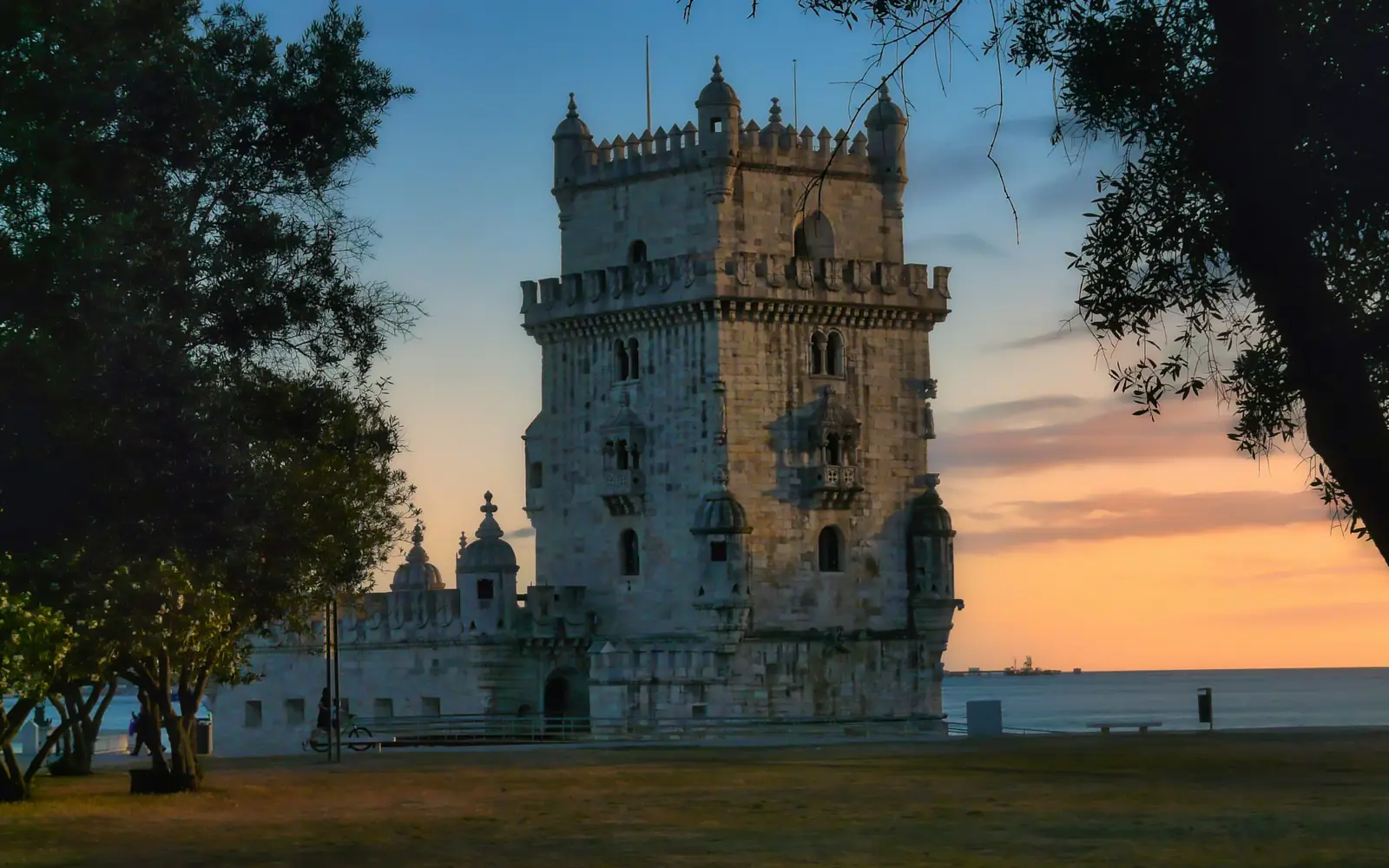
Sister UNESCO site, 300m along the riverfront — captured in our combo ticket
The Tower of Belém was built 1514-1520 as a ceremonial gateway to Lisbon and a defensive fort. It is the same UNESCO listing as the monastery and the same operator. Our combo ticket reserves entry slots at both monuments on the same morning.
Covered by the combo ticket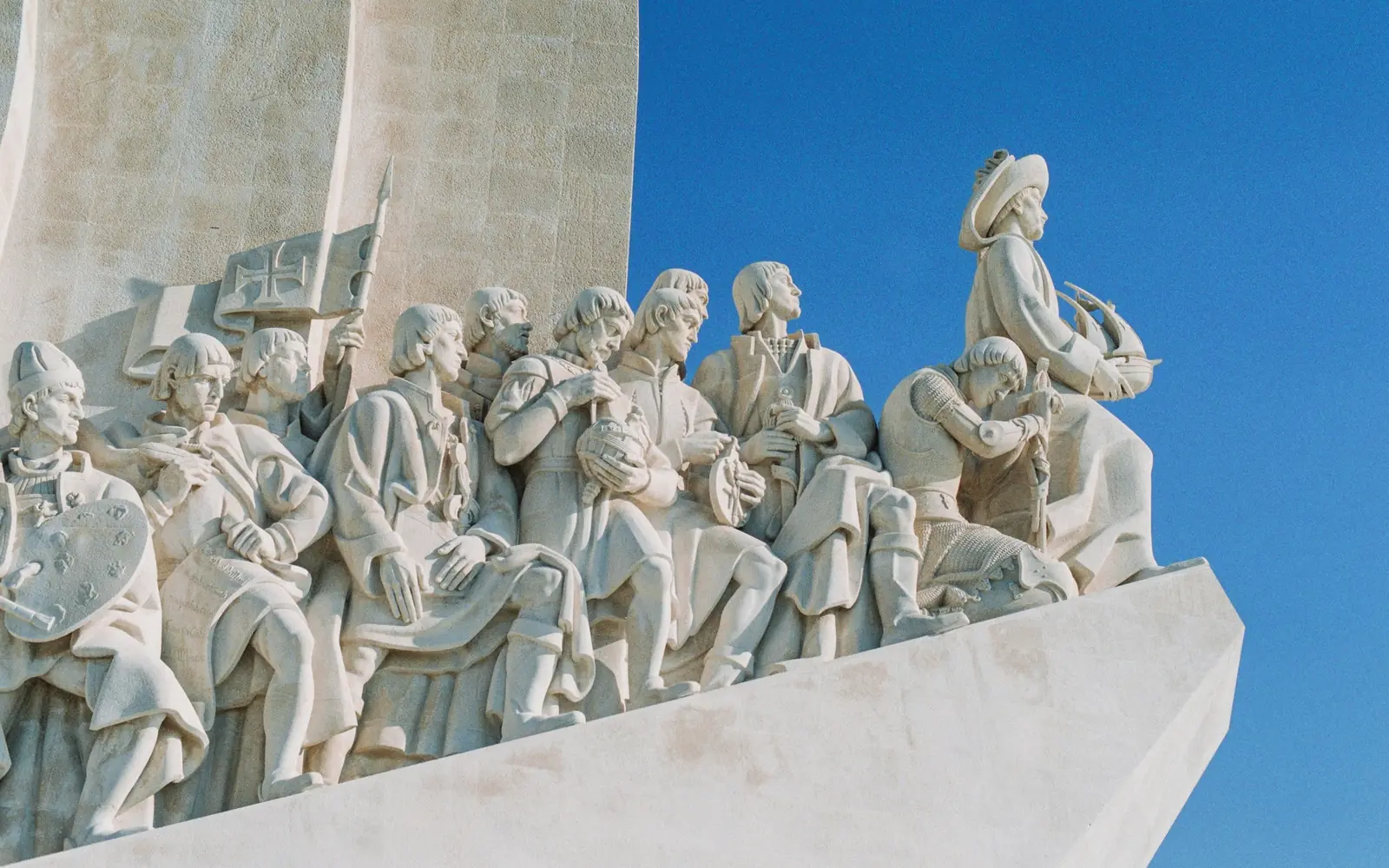
Monument to the Discoveries — 200m from the monastery, free to view from the riverfront
A 1960 modernist sculpture commemorating Portugal's Age of Discoveries. The 56-metre limestone prow shows Henry the Navigator at the front and 32 figures behind him. The rooftop offers the best view of the monastery from above.
Outside view free · rooftop small fee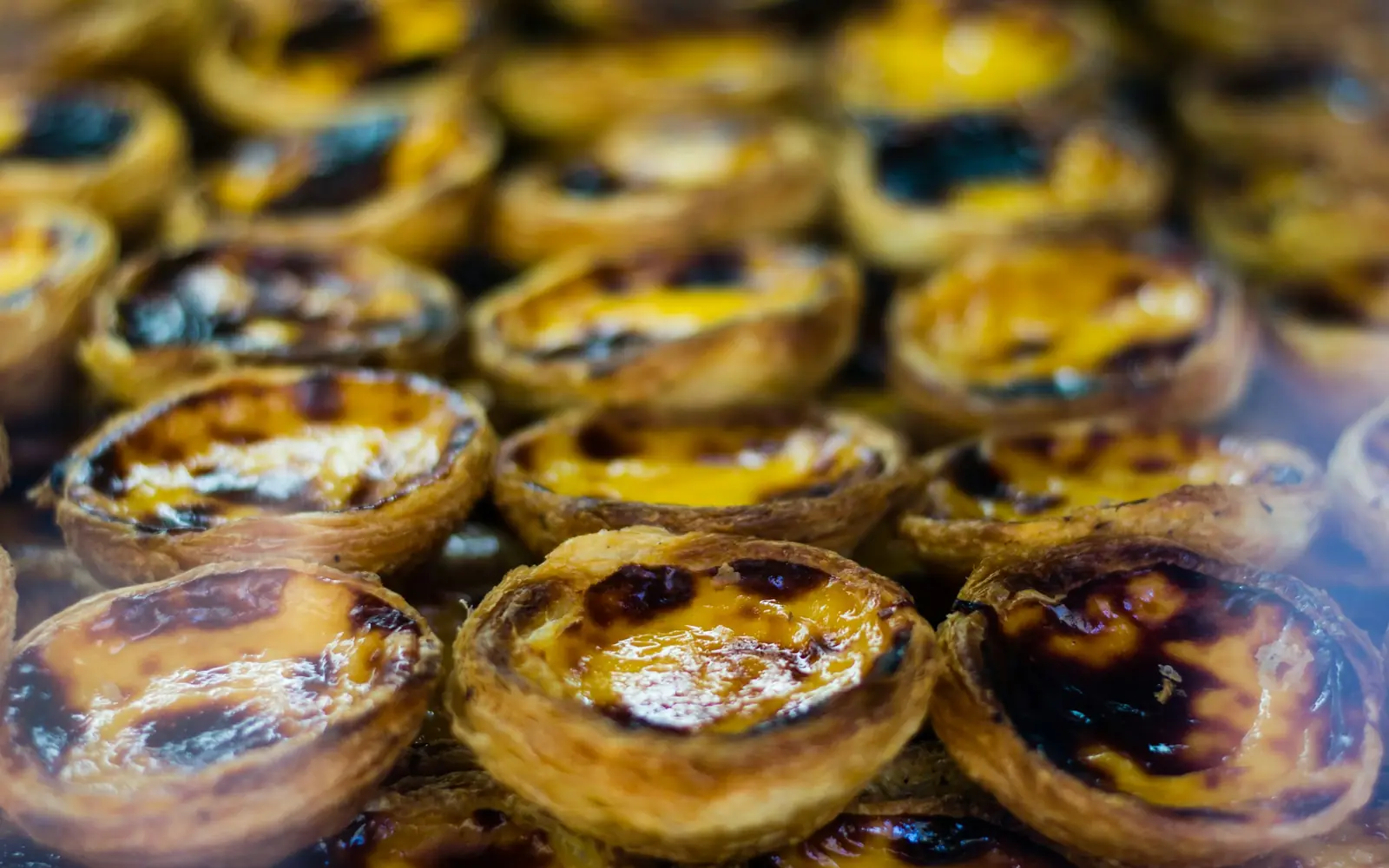
The original 19th-century pastel de nata bakery, 200m east of the monastery
Opened 1837. Same recipe ever since. The pastéis are warm-out-of-the-oven and noticeably better than supermarket versions. Expect a 20-minute queue at the takeaway window or 40 minutes for a table inside.
Cafe — pay on the dayArticles of service
Belém Monastery Tickets acts as a facilitator to assist international visitors in purchasing skip-the-line tickets directly from Museus e Monumentos de Portugal, the official operator. We do not resell tickets — we provide a personalised booking and support service in your own language. For those who prefer to purchase directly, the official ticket site is bilheteira.museusemonumentos.pt.
You pay us once, in your currency. We then buy your dated ticket from the operator, email it to you, and remain reachable until you have walked through the gate.